Open WebUI

Free & Open Source

An extensible, feature-rich, and user-friendly self-hosted AI platform designed to operate entirely offline. It supports Ollama and OpenAI-compatible APIs, making it a powerful, provider-agnostic solution for both local and cloud-based models.

5.0

About Open WebUI

Introduction

Open WebUI is a feature-rich, self-hosted AI platform that allows users to interact with various AI models, including Ollama and OpenAI-compatible APIs, entirely offline. It serves as a powerful, provider-agnostic solution for managing both local and cloud-based AI resources, offering a customizable alternative for those seeking more control over their AI deployments compared to services like Gemini.

Features

Open WebUI provides a robust set of features for individuals and organizations looking for a flexible AI chat interface:

  • Offline Operation: Runs completely offline and is self-hosted, ensuring data privacy and control.
  • Multi-Model Support: Compatible with multiple AI models such as Ollama, OpenAI, Claude, and Llama 3.1, along with other OpenAI-compatible APIs.
  • Document Analysis (RAG): Offers document upload and analysis capabilities through integrated Retrieval Augmented Generation (RAG).
  • Real-time Information: Integrates real-time web search for up-to-date information.
  • Analytics Dashboard: Provides an analytics dashboard for tracking usage insights.
  • Scalable Storage: Supports cloud storage backends like S3, GCS, and Azure Blob Storage for enhanced scalability.
  • Advanced User Management: Includes OAuth management for user groups and SCIM 2.0 automated provisioning.
  • Extensible Architecture: Features a Pipelines Plugin Framework for further customization and extensibility.
  • Security & Compliance: Offers enterprise-grade security and compliance features, including SOC 2, HIPAA, and GDPR.
  • Code Execution: Supports running LLM-generated Python code directly in the browser.
Alternative to

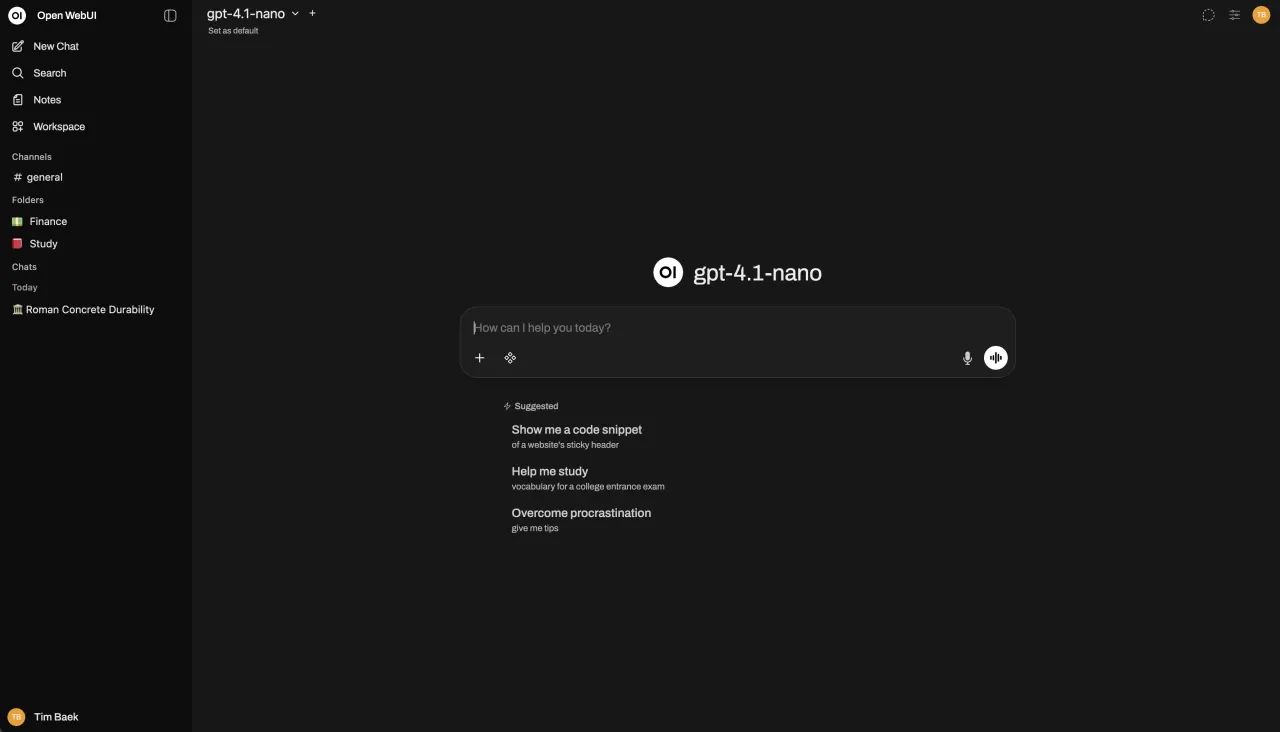
Screenshots

Pros & Cons

Pros

  • Completely free and open-source for the core platform.
  • Self-hosted and runs entirely offline.
  • Supports multiple AI models (Ollama, OpenAI, Claude, Llama 3.1) and OpenAI-compatible APIs.
  • Document upload and analysis with RAG capabilities.
  • Real-time web search integration.
  • Analytics dashboard for usage insights.
  • Cloud storage backend support (S3, GCS, Azure Blob Storage) for scalability.
  • OAuth management for user groups and SCIM 2.0 automated provisioning.
  • Persistent and scalable configuration stored in a database.
  • Portable import/export of configurations.
  • Supports running LLM-generated Python code in the browser.
  • Extensible with a Pipelines Plugin Framework.
  • Enterprise-grade security and compliance features (SOC 2, HIPAA, GDPR, FedRAMP, ISO 27001).
  • Reliable, scalable, and performance-optimized for large deployments.
  • Fully customizable and modular.
  • Cost-efficient as users only pay for API tokens (if using external APIs).

Cons

  • Primarily designed for technically experienced users.
  • Installation can be complex without Docker knowledge.
  • Fewer business features such as advanced team management or role concepts compared to dedicated enterprise solutions.
  • Integrated RAG pipeline is simple and less scalable for a large number of documents (e.g., more than twenty).
  • User management could be improved (e.g., no strict user validation on registration, potential for impersonation).
  • Limitations appear when deploying on a very large scale (1000+ users, 200+ requests/second).
  • Default SQLite database not officially supported on network filesystems, leading to potential data corruption in some cloud deployments.
  • High network latency and low IOPS with cloud storage for SQLite can lead to slow response times under concurrent load.
  • Maintaining many provider integrations is a challenge for volunteer contributors, impacting updates, compatibility, and technical complexity.

Similar Free Tools

Tool Pricing Description Rating